Escalators in Japan: Stand Left or Right, and Why You're Now Asked Not to Walk
Ride an escalator in Tokyo (Tokyo) and most people stand on the left, leaving the right side for people walking up. Go to Osaka (Osaka) and it's the other way around. It's one of the first things many visitors notice. But there's a twist: the railways, the escalator industry and some local governments now ask everyone to do something else entirely, which is to stand still on both sides and not walk at all. This guide explains the custom, the official request, the two places where standing still is written into local law, and what to do as a visitor so you're safe and nobody minds.
This page may contain affiliate links. If you buy through them, we may earn a commission at no extra cost to you.
- The custom: stand left in Tokyo (Tokyo), right in Osaka (Osaka)
- The official request: don't walk, stand still, hold the handrail
- Local ordinances in Saitama Prefecture and Nagoya (Aichi), with no fines
- Suitcases, strollers, and what to do if someone says "sumimasen" behind you
The custom: one side for standing, one for walking
In much of Japan, people who stand keep to one side so that people in a hurry can walk up the other. Which side depends on where you are:
- Tokyo (Tokyo) and most other areas: stand on the left, walk on the right.
- Osaka (Osaka), Kobe (Hyogo) and nearby: stand on the right, walk on the left.
According to newspaper reports quoting a professor emeritus at Edogawa University who studies escalator culture, the habit of leaving one side open began around 1967 at Hankyu's Umeda Station in Osaka (Osaka), where announcements asked people to keep the left side clear for walkers. In the Tokyo (Tokyo) area, the opposite habit grew up on its own from around 1989. This is custom, not a rule: the railways now ask for the opposite (see below), and according to the Nikkei, Hankyu ended the "keep left clear" announcement in 1998.
The official request: stand still, on both sides
Escalator makers, railways and local governments all say the same thing: an escalator is built for people to stand still on, not to walk up.
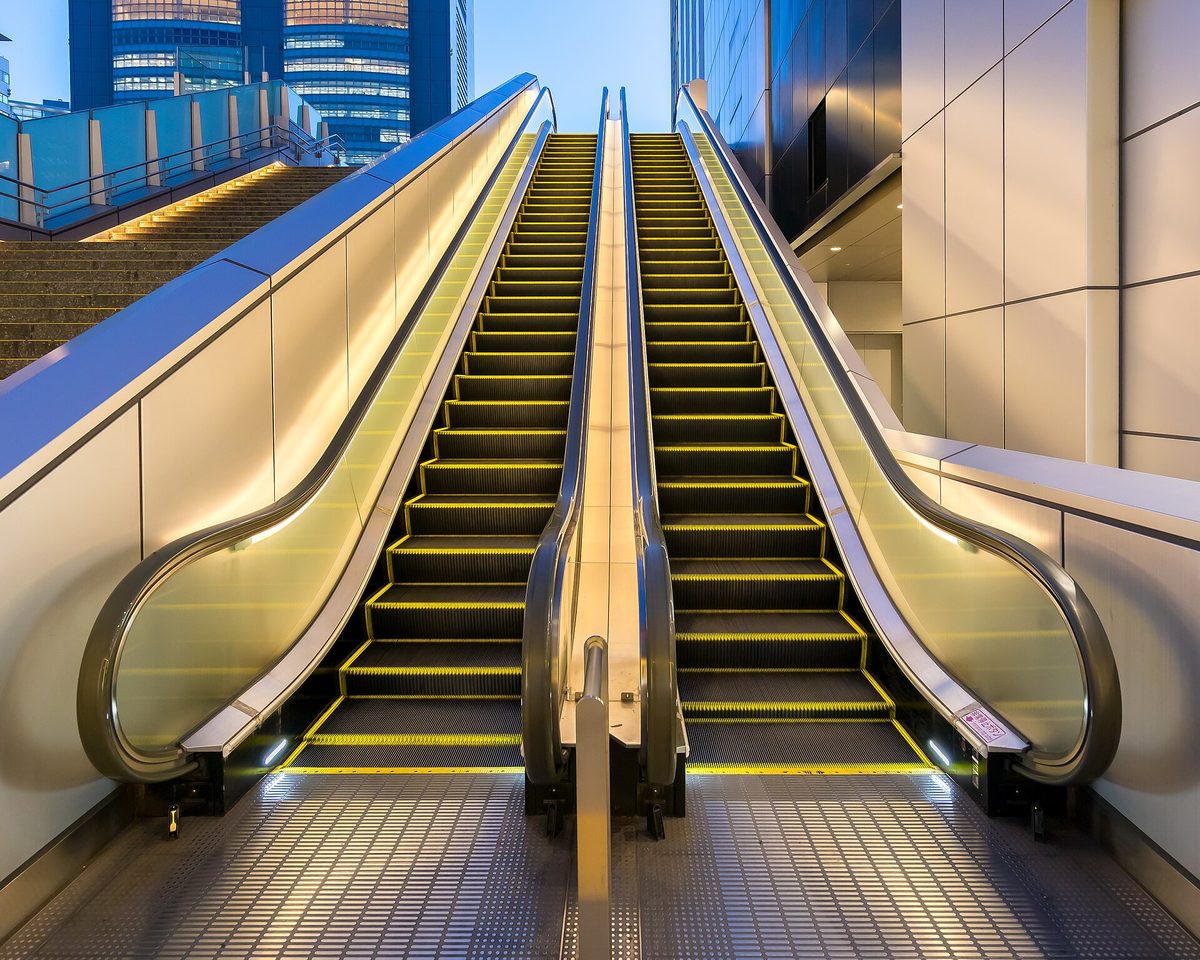
- The Japan Elevator Association asks riders not to walk or run on the steps, to hold the moving handrail, and to stand inside the yellow lines. It warns that walking can make you lose your balance or knock into someone, and that a jolt on the steps can trigger the safety system and stop the escalator suddenly.
- Some people can only hold one handrail. The association points out that leaving one side open for walkers is dangerous for people who can use only one hand, because they may be forced to stand on the side where they can't hold on.
- Railways run a joint summer campaign. In 2026 it ran from July 21 to August 31, with 58 railway companies and transport bureaus and 7 organizations, plus shops and local governments, under the slogans "Don't walk, stand still" and "Hold the handrail." The Ministry of Land, Infrastructure, Transport and Tourism and the Consumer Affairs Agency support it.
Most people in Japan agree, even if habits are slow to change: in the association's 2024 survey, more than 90 percent said walking on escalators should stop, while 60 percent said they sometimes walk.
Where standing still is the law
Two local governments have gone further and written "stand still" into an ordinance (a local law). Neither has a penalty: you won't be fined, but it is an official duty.
| Place | In force since | What riders must do | Penalty |
|---|---|---|---|
| Saitama Prefecture (the first in Japan) | October 1, 2021 | Use escalators while standing still (Article 5) | None |
| Nagoya (Aichi) | October 1, 2023 | Stand still on the steps, whether on the right or the left (Article 8) | None |
Both ordinances also require the operators of escalators, such as stations and shops, to tell riders to stand still. In Nagoya (Aichi), the city's announcements ask people to stand on both sides, and you'll see two lines of people standing at many stations. Saitama Prefecture borders Tokyo (Tokyo); Kawagoe (Saitama) and Omiya Station are both in it.
Custom and official request, side by side
Tips for visitors
- Stand still and hold the handrail. This is what every official source asks, and it's never wrong, in any city.
- Take big suitcases to the elevator. Toshiba Elevator, a maker, asks people not to carry large luggage on escalators, because the bag can fall and hit someone. Keikyu, a railway, asks riders never to let go of their bags on an escalator. Strollers, carts and wheelchairs should not go on escalators at all.
- Don't hurry up the empty side. Even when one side is free, walking or running can make you fall or knock someone over. If you're late, a minute saved isn't worth a fall; the next train will come.
- Step off and move away. Don't stop right at the top or bottom of the escalator to check your map; the Japan Elevator Association asks people to keep the landing clear.
- Hold children's hands. Small children shouldn't ride alone, and should stand inside the yellow lines.
If someone says "sumimasen" behind you
In Tokyo (Tokyo) or Osaka (Osaka), someone walking up may say sumimasen ("excuse me") if you're standing on the side people use for walking. What you do is up to you:
- You're not doing anything wrong by standing. Standing still is the official request, and in Saitama Prefecture and Nagoya (Aichi) it's what the ordinance asks.
- If you'd like to let them pass, only do it safely. Don't let go of the handrail or step across while the escalator is moving if you feel unsteady, or if you're carrying luggage or a child.
- To avoid the situation, join the line most people are standing in when you step on. A small nod or sumimasen in return is plenty; nobody expects more.
Getting around more widely? See trains and buses in Japan, and our guide to priority seats, the Maternity Mark and the Help Mark.
Last reviewed: October 4, 2026. Campaigns and local rules change. Please confirm on the official pages below.
References
- Saitama Prefecture: Safe use of escalators and the ordinance (Japanese)
- Saitama Prefecture: Escalator ordinance, full text (Japanese, PDF)
- Nagoya City (Aichi): Escalator safe use ordinance (Japanese)
- Nagoya City (Aichi) FAQ: About the escalator ordinance (Japanese)
- Research Institute for Local Government: Escalator ordinances in Japan (Japanese, as of November 1, 2025)
- Japan Elevator Association: Using escalators safely (Japanese)
- Japan Elevator Association: 2025 safety campaign and survey results (Japanese, PDF)
- Tokyo Metro: Escalator "Don't walk, stand still" campaign 2026 (Japanese)
- Toshiba Elevator and Building Systems: How to ride an escalator correctly (Japanese)
- Keikyu: Requests for escalator users (Japanese)
- Nikkei: Why Kansai stands on the right (Japanese, December 2014)
- Sankei Shimbun: Osaka-style escalator habit at Expo 2025 (Japanese, May 20, 2025)
- Chunichi Sports: Where standing right and standing left began (Japanese, December 29, 2024)